
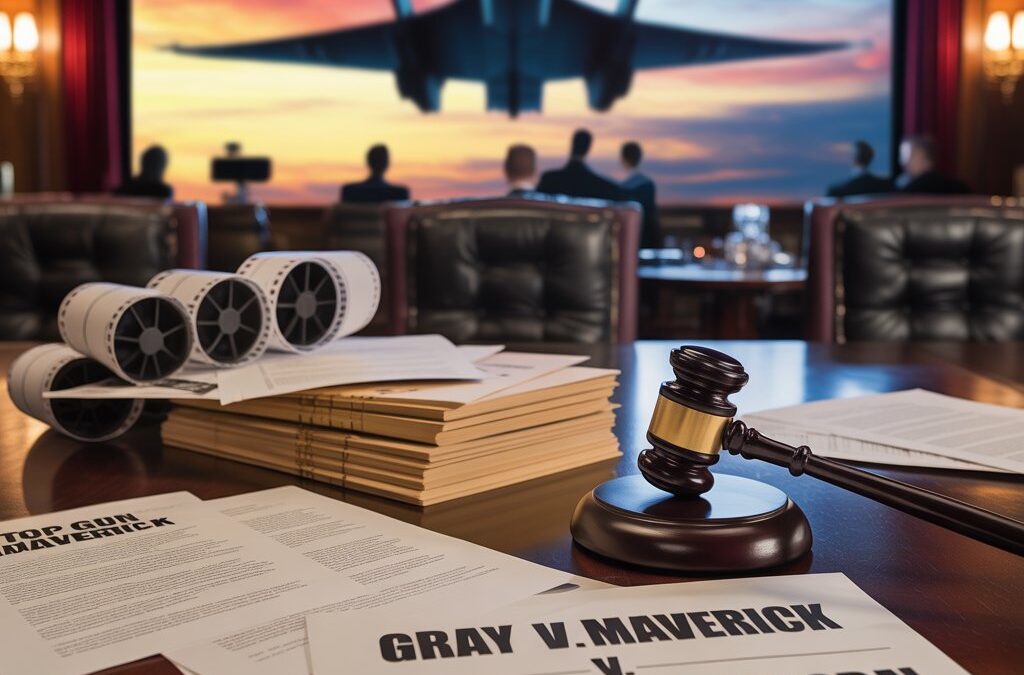
The Top Gun: Maverick case and the protection of cinematographic works
Raffaella Aghemo, Lawyer
I cannot help but write about a legal dispute involving one of my teenage passions and more. I am referring to the copyright lawsuit filed by Shaun Gray against Paramount Global for his contribution to the screenplay of the blockbuster action film starring Tom Cruise, the sequel to the 1986 hit ‘Top Gun’.
In early January 2026, US Federal Judge Jed S. Rakoff of the United States District Court for the Southern District of New York issued a significant ruling in a dispute between an aspiring collaborator on the famous 2022 sequel and Paramount Pictures, the owner of the film rights.
In terms of facts, the dispute (Civil Action №1:25-cv-3484) arose from legal action brought by the cousin of official co-writer Eric Singer, Gray, who claimed to have contributed to writing important parts of the screenplay for Top Gun: Maverick without receiving adequate recognition or compensation, despite, he claimed, his participation having shaped some key scenes in the film, and asked the court to recognize his status as co-author. Maverick without receiving adequate recognition or compensation, despite the fact that, according to him, his participation had shaped some of the film’s key scenes, and asked the court to recognise his status as co-author.
In the lawsuit, Gray claimed that Singer and director Joseph Kosinski contacted him in 2017 to collaborate on the screenplay for ‘Maverick,’ further claiming that he was the only screenwriter on the film who was not subject to a commission contract and, therefore, was entitled to a share of the royalties and profits.
As stated in the April 2025 document, Gray is seeking an equitable and undivided share of all profits derived from the exploitation of the script and the film, including derivatives such as video games and related products, and is also seeking attribution of credit, essentially to be officially recognized as co-author of the script and to receive ‘Screenplay by’ credit in all future copies of the film, in marketing and in derivative works.
Otherwise, in the hypothetical event that co-authorship is not recognized, Gray accuses the defendants of copyright infringement for the unauthorised use of his scenes in the film and derivative products. He is seeking actual damages or, alternatively, maximum statutory damages, as well as an injunction to prevent further infringements.
The defendants have filed a motion to dismiss all three of the plaintiff’s claims.
In the document dated 30 July 2025, the Court partially granted and partially denied the defendants’ motion to dismiss: while it denied with prejudice the claims of co-authorship and co-ownership of the film, as well as the related claim for accounting and payment of profits, it denied the motion to dismiss the claim of copyright infringement, which therefore remains valid.
We are now in the “final stages”, to maintain the bombastic atmosphere of the military fighter jets in the film: Judge Rakoff, having examined the documents, in a document dated 9 January 2026, a few weeks ago, rejected Gray’s main claim for copyright infringement and failure to recognise him as co-author, on the grounds that the alleged “scenes” he described were in fact derivative works of material protected by Paramount and the Top Gun franchise, and therefore could not enjoy their own independent copyright.
In legal terms, the decision states that a work generated on pre-existing creative bases, such as characters, settings and plots linked to the original narrative universe, cannot become an autonomous source of rights if it does not meet the fundamental criteria of originality and expressive independence.
Basically, the main legal reasons are:
1. Shaun Gray’s claim for copyright infringement is INVALID: the Court ruled that the copyright registered by Gray for the “Gray Scenes” is invalid, as it is an unauthorized derivative work: the “Gray Scenes” are based on elements protected by copyright from the original film Top Gun, such as characters, settings and plot. According to copyright law, unauthorized derivative works cannot be protected by copyright.
In addition, there is no ownership right: Gray had signed a contract with Singer’s company, waiving any rights to the materials created for him. Although Gray claims that the contract does not apply to the work done for the ‘Gray Scenes’, the Court ruled that his copyright was invalid despite Gray having registered the copyright.
2. Paramount’s counterclaim for copyright infringement and fraud: Paramount alleges that Gray’s work on the Top Gun: Maverick script was illegally derived from Paramount’s copyright in the original Top Gun film, causing damage to Paramount’s intellectual property. The Court rejected Gray’s arguments for dismissal of the counterclaim, stating that Gray had an obligation to disclose his involvement, given that he possessed superior information not available to Paramount, which, moreover, reasonably relied on its contract with Singer, which provided that Singer was the sole author of the script.
3. Arguments rejected: The Court rejected Gray’s arguments that Paramount’s counterclaims were time-barred. It ruled that the copyright infringement and fraud were only discovered in 2022, when the film was released.
In conclusion, Judge Rakoff granted Paramount’s motion for summary judgment, dismissing Gray’s claim for copyright infringement. Paramount’s counterclaims for copyright infringement and fraud were upheld for trial.
This court ruling has twofold significance: on the one hand, it reaffirms the established logic of US copyright law, according to which a creative contribution must be sufficiently original and detached from the influence of protected works in order to be protected; on the other, it reinforces the position of major film content owners, who can count on established protection of their intellectual property against apocryphal or belated claims.
From a legal point of view, the case offers insights of great doctrinal and practical interest, and two important lessons.
The first lesson is that copyright protection does not protect ideas or facts, but the original expression of those ideas. In cinema, as in literature, this means that mere consistency with an existing narrative universe (such as that of Top Gun) is not enough to generate an exclusive right. Creativity must emerge in sufficiently distinct and autonomous forms.
The second lesson concerns timeliness and transparency in contractual relationships, where it appears crucial to contractually regulate any creative contribution during the production phase, especially when it comes to works of great commercial significance.
Finally, the echo of this decision in the United States is part of a broader debate concerning not only the determination of the boundaries of film copyright, but also the balance between the protection of individual creativity and cultural progress. In an era where franchises, spin-offs and shared narrative universes dominate the global market, judges are faced with the challenge of defining where legal protection begins and ends, and what the limits of copyright are in the context of derivative works.
The case therefore shows, in a very concrete way, where the boundary lies between informal collaboration and protected creation: without a sufficient level of expressive originality and without a clear separation from the pre-existing work, the creative contribution remains legally irrelevant, even if artistically appreciable. This is a fundamental lesson for those working in the narrative development of audiovisual products with high commercial value.
Ultimately, Rakoff’s decision in Gray v. Paramount represents an important confirmation of the copyright architecture in the United States, which favours contractual clarity and expressive distinctiveness. For studios, authors and lawyers in the industry, it serves as a warning: in the era of global franchises and complex collaborations, the legal system requires not only creativity, but also contractual rigour and compliance with intellectual property protection rules.
In the film industry, especially in large studios, it is standard practice to regulate every contribution through “work made for hire” contracts or advance assignment agreements. These instruments serve precisely to avoid subsequent claims and to clarify, from the outset, who owns the rights to exploit the work commercially. In the Top Gun: Maverick case, the lack of any formalization allowed Paramount not only to defend itself effectively, but also to bring counterclaims for copyright infringement and fraud.
For those who wish to read the 9 January decision, here is the link: https://law.justia.com/cases/federal/district-courts/new-york/nysdce/1:2025cv03484/641356/128/